
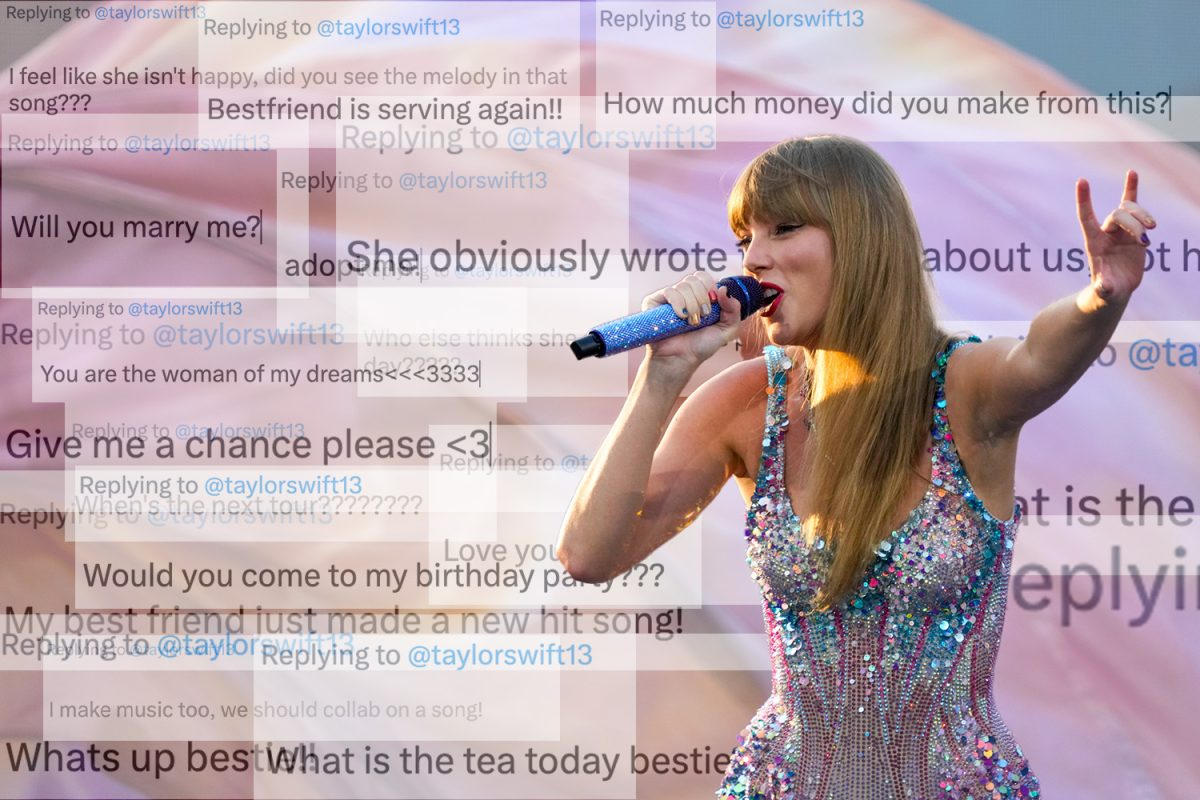
A casual fan of Taylor Swift sits at one end of the “fan-to-parasocial” spectrum. Perhaps they find her music catchy or view her as a role model. At the opposite end of the spectrum are “extreme Swifties,” people who are often perfect examples of modern-day parasocial relationships. Those who fall into this category claim intimate connections to Swift, believing they can intuit her thoughts and feelings as if she were a close friend. One subculture of Swifties, known as “Gaylors,” insist Swift is a closeted lesbian. Basing their assertions on a perceived “connection,” they closely scrutinize her female friendships and interpret supposed queer undertones in her music, even voicing “genuine fear” when Swift announced her engagement to Travis Kelce.
As fan culture continues to expand, “parasocial relationships” are becoming increasingly mainstream. Although often used as an internet buzzword, the term is frequently misunderstood. While the two are frequently conflated, having a parasocial relationship is not the same as being a fan. Fandom involves an appreciation for an artist’s work, whereas parasocial relationships describe nonreciprocal socio-emotional connections in which a person develops a deep sense of intimacy with someone they don’t personally know, often a celebrity or other media figure.
These relationships are not as uncommon as one might think. The human brain is inherently social, so when individuals feel lonely, they may seek a digital surrogate to find a sense of comfort or companionship. These one sided relationships are uniquely appealing because of their less-demanding nature—there are no favors to return, conflicts to navigate, or expectations to meet. Teens in the digital age are particularly vulnerable to this because of their natural inclination to recognize familiar online faces and develop positive emotional attachments.
The surge in parasocial relationships has been fueled by social media and AI. While social media is not the sole cause, it provides the public with unprecedented access to private details about a media figure. “Day in the Life” or “Get Ready With Me” style videos invite viewers into influencers’ daily lives, making them appear authentic and relatable while activating the same psychological pathways associated with real-life friendships. This fosters a false sense of “knowing” the influencer, even if the relationship remains one-sided. AI chatbots further contribute by simulating human-like interaction and connection. The use of AI as therapists, companions, and even romantic partners continues to grow. In one extreme case, a woman named Yurina Noguchi reportedly attempted to marry an AI-generated persona named Klaus through ChatGPT.
In recent years, psychologists have linked parasocial relationships to obsessive compulsive disorder (OCD) and celebrity worship syndrome, a form of attachment with clinical implications. At this level of obsession, parasocial relationships can become harmful or even dangerous. One possible outcome is stalking, which can range from following the celebrity to breaking into their homes. In the most extreme cases, these behaviors escalate to assault and murder. In 1980, Mark David Chapman fatally shot John Lennon outside of his apartment because he felt that Lennon had betrayed his message of peace and love, and, by extension, Chapman’s trust. Similarly, in 1981, John Hinckley Jr. shot President Ronald Reagan in an attempt to impress Jodie Foster, with whom he was completely infatuated.
Parasocial relationships of this extreme are rare, but it is vital to stay aware. Teenage brains are still developing, making it especially important to monitor influences that can affect emotional growth. While parasocial relationships may offer comfort, they should never compromise safety, mental health, or real-life relationships. Moreover, although celebrities and influencers are constantly placed in the public eye, they remain entitled to privacy and safety. In the digital age, it is important to be conscious of our online behavior, lest harmless fandom turns to obsession.