
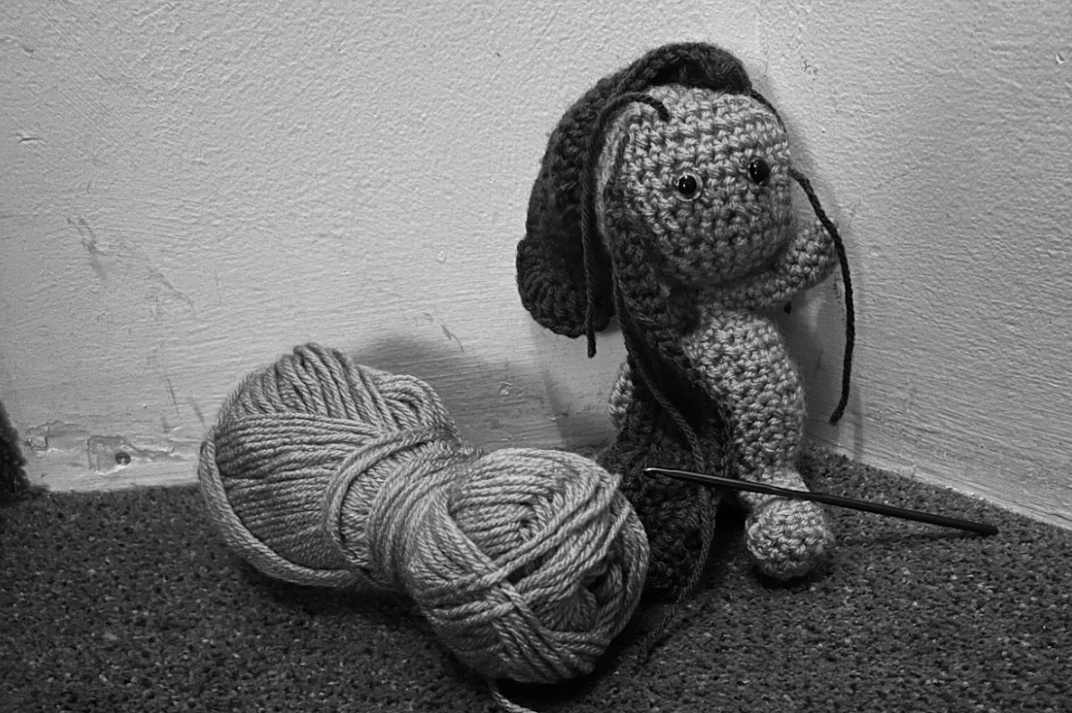
The lunch bell had only just rung, but the members of the Art Community Club were already chattering cheerfully as they pushed together desks and collected crafting supplies. The club is just one indicator of the spike in popularity that domestic crafts, or “grandma hobbies”, are experiencing among Gen-Zers. Some feminist theorists claim that the uptick of crafters has the potential to create social change.
“History showed us that sometimes the great revolutions begin with very small gestures,” said feminist philosopher Natalia Anna Michna. “Sometimes we just don’t know that what we’re doing is going to change the world radically.”
In the 1960s and ‘70s, feminist artists used domestic crafts to create art, challenging the dominant narrative that only traditional mediums of paints and sculpture could be deemed “art.” Feminists highlighted the tasks women had been doing for centuries by yarn bombing (quickly covering objects with a knitted or crocheted layer), creating intricately quilted tapestries, and embroidering political messages.
“The feminists were the first to… reclaim [domestic crafts] as meaningful and important,” Michna posits. “They brought our attention to all those practices that were devalued or omitted by traditional… arts.”
At the time, such art required an audience for it to truly shift the narrative but today, the activism in domestic crafts lies in the smallness of it. Postsocialist feminists like Michna theorize that everyday acts of feminism are just as important as larger, more public acts. Grandma hobbies can create change through the communities they create.
“When you meet to do some handicrafts together—to sit together and knit or embroider, or anything, you do not have to be seen, you do not have to act,” described Michna. “You just sit and do it, and can talk, and can think, and can be together.”
The Art Community Club exemplifies this principle. One reason why Alexandra Frances started the club was “to have all [her] friends in one space and be able to do fun arts and crafts together and build a smaller community.”
Domestic handicrafts, according to Michna, are intergenerational, a principle with which Susanne Schuster, a grandma of Rockridge, has experience.
“[My grandchildren and I] like to cook together,” she mentioned. “And we’ve always done that. There’s wonderful children’s cookbooks and we’d go to the store, and get the right rice to make sushi, and talk to the person at Safeway that made sushi, and she would give us ideas…”
Schuster has been crafting since kindergarten, when her teacher taught her to knit. She later learned how to sew from her godmother who lived down the street. But Schuster is hesitant to call her art feminist. She never imagined that her knitting or sewing could create feminist change. She values public displays of dissent over the weak resistance of postsocialist feminism.
“I would just use anything I could to get what I wanted in that area,” remembered Schuster. “But I didn’t have anything that lent itself very well other than a screaming voice and the ability to walk.”
Whether or not grandma hobbies truly constitute a new feminist movement, they have worthwhile qualities.
“When you meet with your friends to do some knitting, or embroidery, or anything, there is no hierarchy, right? You’re just equals, you’re just people who gather together to do something together, not thinking about who’s… better, or more efficient,” explained Michna. “Needlework is not about being efficient, it’s about being attentive, and more about being caring, caring of what you’re doing, but also caring of people around you.”
Domestic crafts create community, increase connections between people, and offer a new way to approach the world. The next time you see a needle and some yarn lying around, maybe it is worth creating something—you never know what it may lead to.