
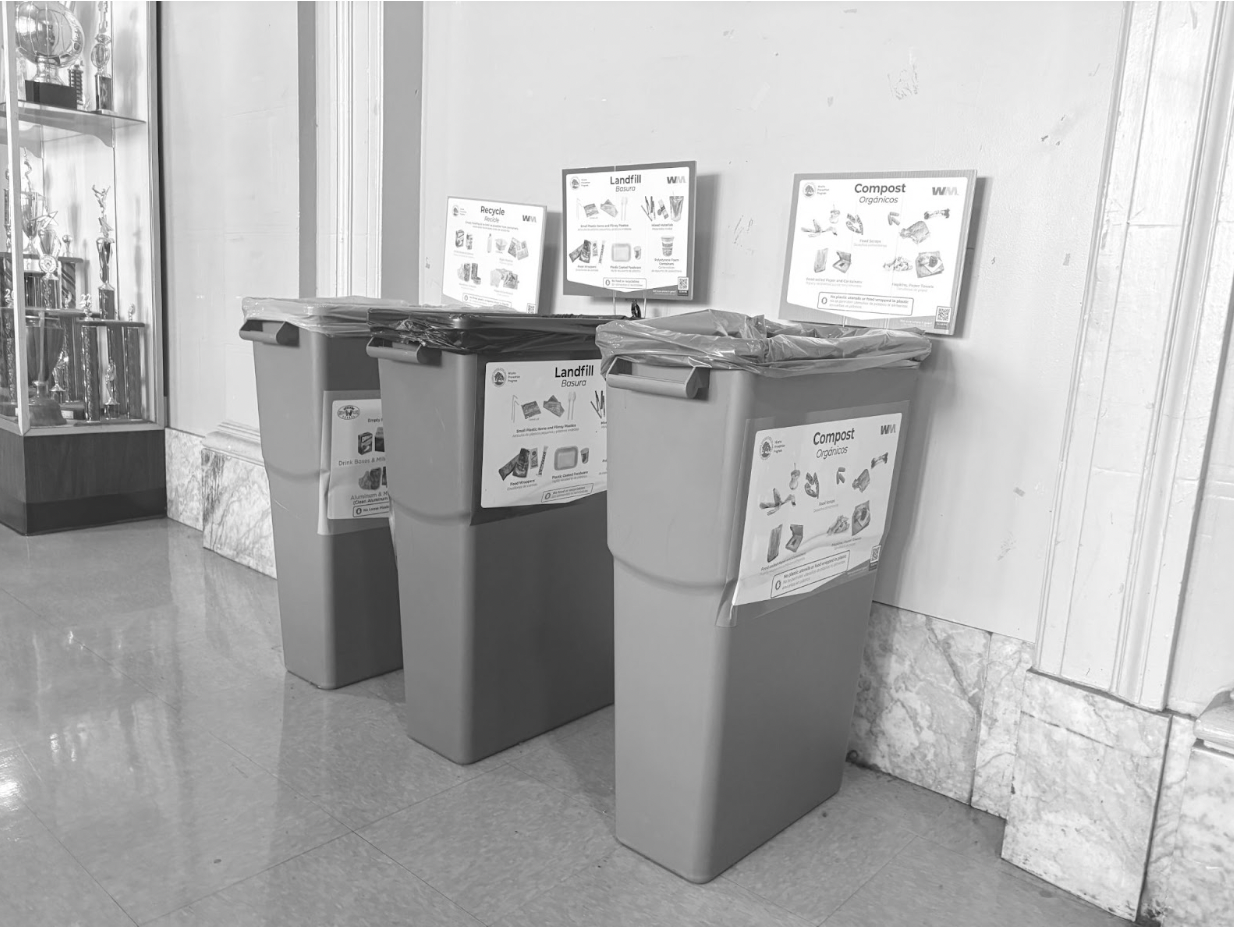
Oakland Tech’s compost and recycling program has improved immensely, yet severe flaws still remain.
Issues with the system include a lack of communication between the district, administration, and school population regarding Tech’s recycling policies, and that recycling or compost has been contaminated with other waste. Custodial staff do not have time to sort items and are expected to decide whether a bin is too contaminated to be recycled.
Nancy Deming, the district sustainability manager, describes sorting trash as “a very action-oriented thing that we can do throughout our day [as] part of our lifestyle.”
Oakland Tech is not the only school struggling with sorting waste, despite California public schools being required to recycle and compost per CalRecycle’s SB1383 law. It is a common challenge for schools to compost and recycle adequately, and many in the state do not manage to comply with regulations.
The main failure is a lack of clarity around the amount of recycling and composting that actually occurs, and the dumpsters by the tennis courts do not offer a clear picture. The recycling dumpsters are partially filled with office paper waste, such as cardboard boxes, instead of classes’ recycling, like sheets of paper. The singular compost dumpster is empty, except for a small amount of tree branches, debris, and some trash bags. Head Custodian Karl Jeffries claims the bags are compostable, despite being thick plastic, and quite different in appearance than biodegradable bags.
Sustainability at Tech is a controversial issue. School administration believes the school is understaffed and more urgent issues should be prioritized over sustainable waste management. Custodial staff emphasize the importance of teacher and student support, through waste sorting.
“We just need some help from teachers and students to participate more,” commented Jeffries.
The school administration comments that recycling and composting issues could be addressed better if more time and resources could be allotted. “We are asking one human being to do 20 different jobs, and then we criticize or we say to that individual, ‘we need you to do one more thing,’” explains Assistant Principal De’Shawn Woolridge.
School administration and the district do not seem to be on the same page regarding recycling and compost policy. Deming, who works on sustainability projects in schools around the Bay Area, regularly takes into consideration CalRecycle regulations. Yet, the requirements the school has to follow regarding recycling and composting were unfamiliar to Woolridge.
Environmental Science teacher Joseph Senn wants to encourage a mindset of accountability and problem-solving about recycling and compost. “[We must] inspire people to think more about their surroundings instead of always pushing the blame or pushing the responsibility all to others,” said Senn.
In the past, students have worked hard to emphasize the importance of recycling and composting properly, but that advocacy has lessened somewhat since the pandemic. Jeffries explained that many students who worked on these projects have graduated, without a new generation to replace them.
The Oakland Tech staff, altogether, emphasizes the importance of educating students in awareness of how compost and recycling affects the environment. Recycling papers, plastics, and metals limit the amount of natural resources that are depleted, and composting organic waste reduces greenhouse gas emissions.
In the future, Senn’s classes will work with Deming to use a new AI tool that will paint a clearer picture of actual recycling processes at Tech. The platform is set to use images to analyze how well the school is properly sorting waste and should allow students to participate in the process of coming up with waste management solutions at school.