
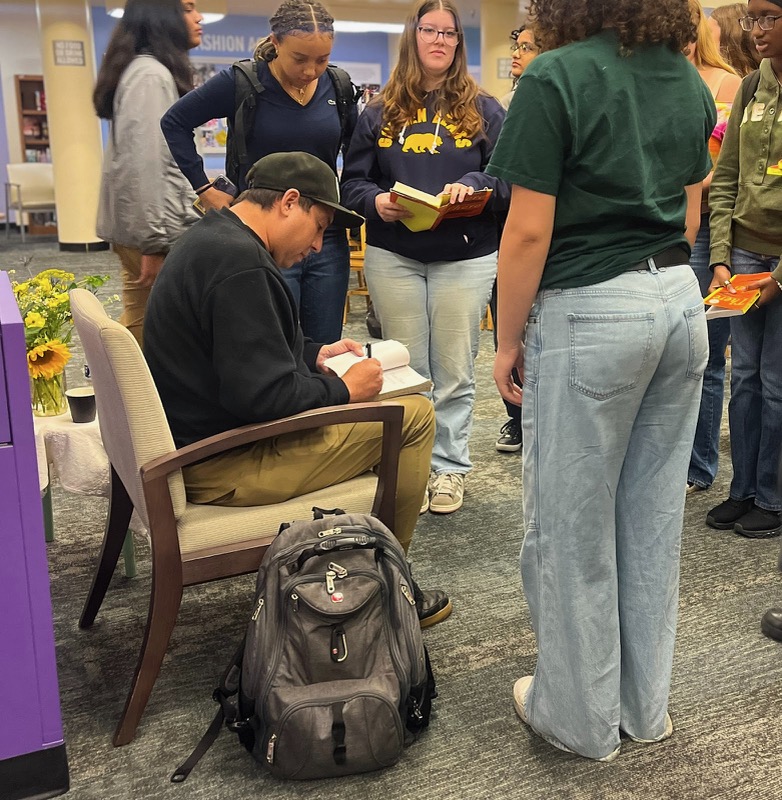
On Friday, October 10, a sudden excitement rose among the student and teacher body of Oakland Tech. Tommy Orange, a Pulitzer prize finalist and author of “There, There,” would soon open up to a panel of student questions in Oakland Tech’s library.
Tommy Orange has been long revered in the greater Bay Area community, yet his work as a writer particularly resonates within the city of Oakland. At Tech specifically, Tommy Orange’s“There, There” is essential to Ms. Laberge’s RPL curriculum, which studies how people of various cultural backgrounds interact with the American system.
Ms. Laberge noticed how kids were rarely “able to read stories from historically marginalized groups,” and began teaching“There, There” as a way to connect them to this narrative they may not otherwise discover. Additionally, Ms. Laberge wanted to share the beautiful way Tommy Orange writes as an example of how amazing artists can come from their hometown that is often given a bad reputation.
At the entrance of the library, her students greeted a swarm of students who piled through the two entryway doors. Behind them, the library’s surfaces held vases of sunflowers and yellow daisies. Rows of brown wooden chairs seated students from a variety of grades, most of whom held colored notecards with handwritten questions on them. When Tommy Orange began walking down the ramp into the library, every student raised their hands in applause.
For the following hour and a half, a mic was passed around the room and sparked conversations between students and Orange. One student asked Orange how he found inspiration for“There, There,” but the answer was not simple.
Orange first clarified how fiction is “pulling from the imagination just as much as your lived experience.” Then, he explained how “the way this country tells the story about itself doesn’t really include Native people,” so the use of storytelling by Native people themselves is crucial for creating a complex, human, and nuanced narrative. Ultimately, the inspiration for his artistry is to capture the experience of being Native American in a way that reflects both reality and the spirit of Native culture.
When asked how storytelling holds its own value in activism over other modes of persuasion, Orange responded,
“Storytelling is at the base of everyone’s [attempts] to communicate with the outside world, language is built around story. So, I think sometimes storytelling is put into this [category], especially with native people, of oral storytelling around the fire with myths. And I think, we’re all doing storytelling all the time in a way that we don’t always recognize.”
Rather than storytelling being a tradition performed during gatherings, or a craft that’s practiced in novels, Orange communicates that storytelling is a natural response to life that arises everyday as an act of “trying to capture people’s imagination.”
However, Orange long struggled to find these stories that would eventually captivate his mind. The ill representation of himself and his culture bred a lonely feeling of devaluation so he naturally began to turn away from the media.
However, his curiosity for art sparked when he found “people who seemed to have a lot of urgency.” Sylvia Plath, John Kennedy Toole, Jimi Hendrix and Nick Drake were all artists who displayed this trait of urgency which often led to their own suicides or demise. Their fates were reminiscent of Orange’s upbringing in the Evangelical church where he was often taught that the world was going to end.
However Tommy Orange continues to write in spite of how he was forced to believe that he would be erased, as he and other Native American artists have always been threatened.
Although the lives of these artists ended in tragedy, Tommy Orange envisions a future where artists can prevail against the erasure that American leaders want to force onto people like him.
Instead of letting it overtake him, Orange wrote his own stories and reworked the narrative that the oppressive world intends many of us to follow. He is a reminder that the fate of our lives can be reclaimed by telling our own stories and the stories of our people.