
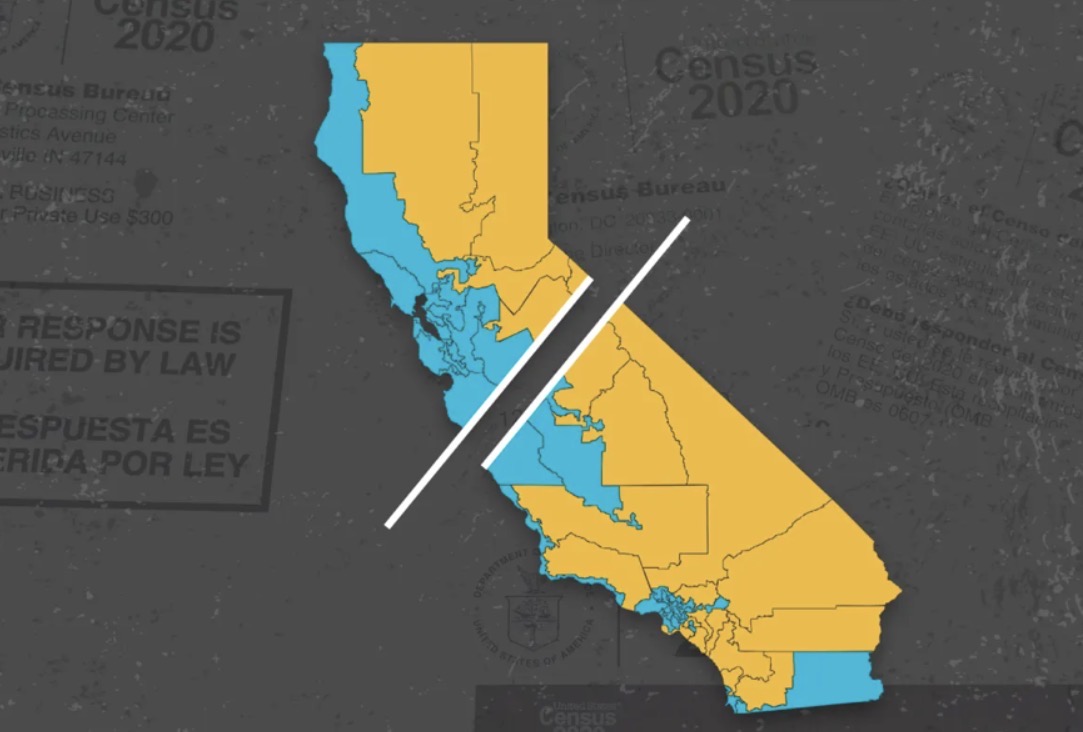
In anticipation of the upcoming 2026 Congressional midterms, Texas Governor Greg Abbott has approved a new Congressional district map. The map is designed to give Republicans five more seats in the House of Representatives in order to maintain their narrow majority, a practice also known as “gerrymandering.”
This redistricting has sent many Democratic states into panic, as President Donald Trump and the GOP continue their push to maintain control of Congress using methods far outside of the norm. California governor Gavin Newsom is preparing to offset this action by advocating for the state legislature to redraw California district lines in a way that will favor Democrats.
But what is gerrymandering? Gerrymandering is the practice of dividing a territory into election districts designed to give a certain political party an unfair advantage in elections.
There are two common methods of gerrymandering: “cracking” and “packing.” Cracking refers to the process of splitting a voting group across districts to weaken their electoral power. Packing is the opposite, cramming groups of voters into a small number of districts so that their vote takes an overwhelming majority in those areas, even though they lose voting power elsewhere. While legal, gerrymandered maps create a dangerous system where politicians choose their voters instead of voters choosing their politicians.
California has previously worked to prevent this practice with legislation. In 2008, California passed the Voters First Act, which authorized the creation of the California Citizens Redistricting Commission. The Commission is intended to remove party politics from the process of redistricting, which occurs every 10 years following the census. The Commission draws the lines for Congressional, State Senate, State Assembly and State Board of Equalization districts, following nonpartisan rules designed to create districts of roughly equal population in order to provide fair representation to all citizens. The Commission itself also attempts to be nonpartisan, consisting of five Democrats, five Republicans, and four members not affiliated with either party.
However, Newsom’s proposed plan would override the Commission’s authority. Newsom plans to put Proposition 50 on the special election ballot in November of this year, a measure that proposes amending California’s state constitution to allow the state legislature to draw new Congressional district maps. So, what would your vote mean?
Voting “yes” means that California will temporarily use the new legislature-drawn maps for elections starting in 2026. Voting “no” means that the district maps drawn by the California Citizens Redistricting Commission will continue to be used. While the measure does ensure that the redistricting power of the Commission will resume as usual in 2030, following the next census, the legislation drawn map would be used in California Congressional elections through that year.
This measure has sparked a contentious debate concerning future elections and our role in them as California citizens. Supporters argue that it is necessary to counteract national gerrymandering and protect the crucial balance of power within the legislative branch. Opponents of the measure argue that it sets a dangerous precedent for the future of California politics and allows state power to undermine that of the people.
Whatever the conclusion is, it is crucial that we find a way to maintain free and fair elections both in the state and the nation as a whole. Your vote matters!