
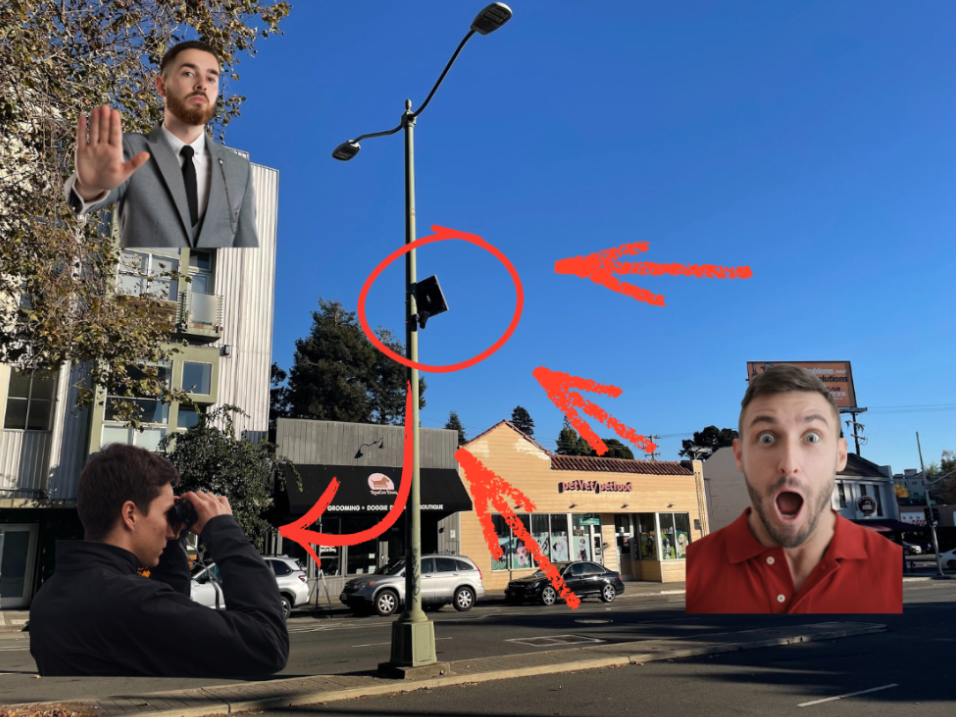
Data centers, artificial intelligence, and Flock cameras, oh my! This Halloween, nothing is spookier than being watched. All around Oakland, Flock cameras perched on poles silently observe every car that drives by, compiling information in a database somewhere far away.
Flock Group Inc. is a tech company that sells AI surveillance technology to reduce crime. Their flagship item is their license-plate-reading cameras. Every single car that drives by one of these Flock cameras gets automatically photographed. License plate numbers, models, colors, and any other defining characteristics of the car are recorded, including dents, scratches, bike racks, toolboxes, and even bumper stickers. Artificial intelligence then organizes and sorts these notable features into a massive database to create a vehicle fingerprint.
On their website, Flock claims, “Flock cameras are not general-purpose surveillance systems designed to identify people. They are built to focus on the vehicle”. However, Flock’s patent says the exact opposite, detailing how the technology can detect a “statistically similar person” and then alert a subscriber. Moreover, Flock’s FreeForm service gives police a search bar to look for people by clothing, height, gender, race and tattoos; all without a warrant. Bicyclists and pedestrians who end up in the frame of a Flock camera could be added to the database as well.
This technology has hardly any regulation or oversight, leading to a long list of issues. Cops have repeatedly profiled people, wrongfully arrested innocents, shared camera data with ICE, stalked their exes, and even tracked a woman across state lines for allegedly having an abortion. In response, an Oklahoma judge claimed that because the cameras are automatic, they could infringe on the 4th amendment right to privacy.
Robert Barrett, who teaches AP and Comparative Government at Tech, said, “[The Founding Fathers] definitely had some fear and desire to protect people from government surveillance… so I think they would see [Flock] as another example that, if not properly regulated, could lead to a lot of that government overreach.”
Flock has taken the country by storm and currently reports to cameras in 49 states, despite the fact that the company is less than a decade old. In 2024, Flock had less than 40,000 cameras in the U.S. Now, there are over 120,000, and rising. Oakland alone has between 300-500 cameras, according to different sources. Eight of these are on Broadway, one of which watches over Tech from the north end of campus. Just two years ago, Oakland was Flock-free.
Compared to Oakland, Piedmont has only a few Flock cameras within the interior of the city. The vast majority of Piedmont’s cameras are on the border of the municipality. There are upwards of forty Flock cameras, positioned in a way so you cannot leave or enter without being seen.
Escaping a Flock camera is easier said than done. Flock has bragged its cameras can “capture vehicles traveling up to 100 MPH, day and night, and up to 75 ft away.” Some are choosing fight over flight.. Across the U.S., people are destroying and defacing Flock cameras as part of an online “Deflock” movement. Many videos have gone viral encouraging a “Deflock Halloween,” where everyone dresses up and destroys Flock cameras while disguised in costumes.
Whether or not this event actually occurs remains to be seen, but one thing is certain about Halloween night: the Flock cameras will be watching.