
California is moving towards a new era of a “phone-free” education. Following the signing of Assembly Bill 3216, also known as the Phone-Free School Act, every school district and charter school in the state of California is now legally required to adopt a policy that limits or prohibits student phone usage during the school day.
“The success of this change relies on the fidelity of implementation and consistency of enforcement, in order for all stakeholders to experience maximum benefits,” asserted Phone-Free Schools Movement co-founders Sabine Polak and Mileva Repasky in the introduction to a toolkit with resources for school administrators.
The new legislation, signed by Governor Gavin Newsom on September 23, 2024 is now taking into effect with a firm deadline for implementation on July 1, 2026. While some schools have already begun experimenting with various restriction methods, this law ensures that by the start of the new 2026-2027 school year, regulations will be uniform across the entire state.
The push for this new act is rooted in growing concern to address an increased mental health crisis and an attempt to boost academic performance. Data from Common Sense Media shows that approximately 97% of students use their phones during school hours for a median of 43 minutes a day, while a Prew Research Center survey found that 72% of high school teachers view cell phone distractions as a major disruption to learning.
“I think it’s a very necessary change, because of the fact that phones are just an invariable distraction,” said ninth grade teacher Lara Kuan-Haller. “You can just see the difference between a student who has their phone with them throughout that period versus one who doesn’t.”
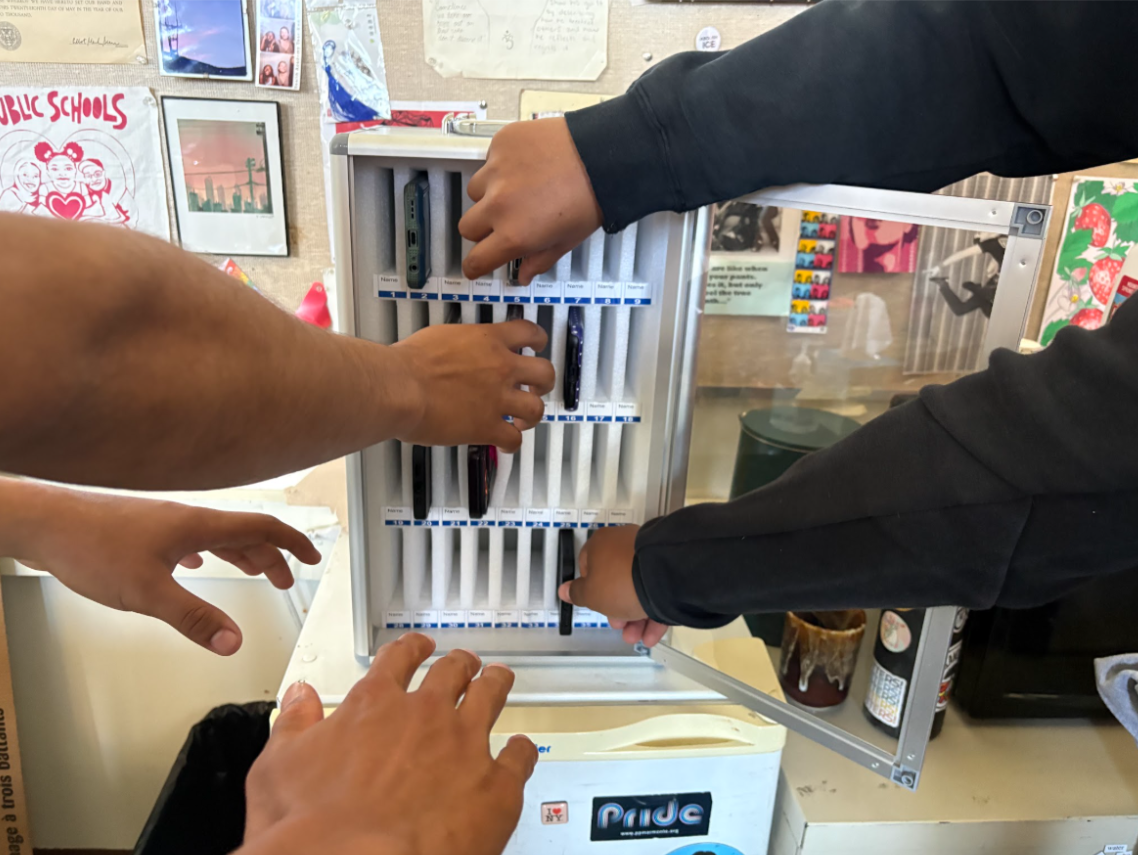
Current policies at Oakland Tech insist that ninth grade teachers use a phone box, where students must deposit phones during class, and encourage other teachers to use them as well. However, a broader policy from the school may put less pressure on teachers to enforce phone rules.
“There’s so many things that every teacher has to look out for in a day that I think that phone box policy can be another step that is very challenging,” explained Kuan-Haller.
While this law is a state mandate, it grants local districts the authority to decide how to enforce the rules. This has led to the testing of several different implementation methods including “off and away” (keeping phones out of sight and in backpacks), Yondr pouches, which are highly magnetic locked bags that prevent students from accessing their devices, and network restrictions. OUSD is considering these methods, as well as zippered pouches that would be handled by administrators and phone lockers, which the Phone-Free School Movement considers to be the most practical for large schools.
Despite this requirement, the law includes a few exceptions to this policy. Schools may choose to allow phone use during genuine emergencies or in response to a perceived threat of danger. This is not recommended by the Phone-Free School Movement program because they can alert assailants of the location of students during a lockdown, distract students during vital instruction, and delay emergency services. Additionally, exceptions are made for students who require mobile devices for health reasons or as a part of the Individualized Education Program (IEP). Teachers also retain the right to permit phone use for specific instructional activities.
There are also concerns about “bell-to-bell” phone policies and their compatibility with off-campus lunch. State recommendations encourage districts to apply policies where phones must be inaccessible to students throughout the entire day, but it is challenging to monitor phone use when they are not on school premises. The school may consider, in the future, not allowing ninth graders to exit campus during lunch, so phone policies may be easier to implement in the lower grades.
The new state-required phone policy will need reworking to meet the specific needs of Oakland Tech, but students should prepare for school to operate differently in the fall.