
For most, the dusty and unentered rooms of Oakland Tech remain unreachable, their vast histories vanishing along with them. Except for Mr. Jefferies, who as both a 1980s alumni and current head custodian, accesses the secrets of these rooms unlike any other. Jefferies’ knowledge of Tech’s layout is rooted in how deeply he knows its history, spanning from the creek which Tech was originally built upon, to the recently opened Wellness Center in the basement level. His expertise has transformed his work from upkeeping the school, into an ongoing process of improvement. To him, setting the school up for success physically is crucial to the performance and overall happiness of the students.
“We want to see things that will encourage kids to want to come to school. They have to have a future, you know what I mean? Have a clean, comfortable school to come to, so after the 12th grade, no one goes home.”
Mr. Jefferies has applied his sociological outlook to issues at Oakland Tech, including last year’s epidemic of students breaking fire-alarm boxes to interrupt class. When the old boxes that lured students into breaking them almost daily were replaced with new, shiny-blue glass, false fire alarms plummeted. Jefferies’ surface-level fix worked by shifting students’ mindsets—from wanting to smash the alarm to viewing them as something nice and worth leaving intact.
Most of Jefferies’ work seems to alter the flow of Oakland Tech without drawing obvious attention, much like the spaces he uses day-to-day which disappear from public view yet contain multitudes of history, and functionality.
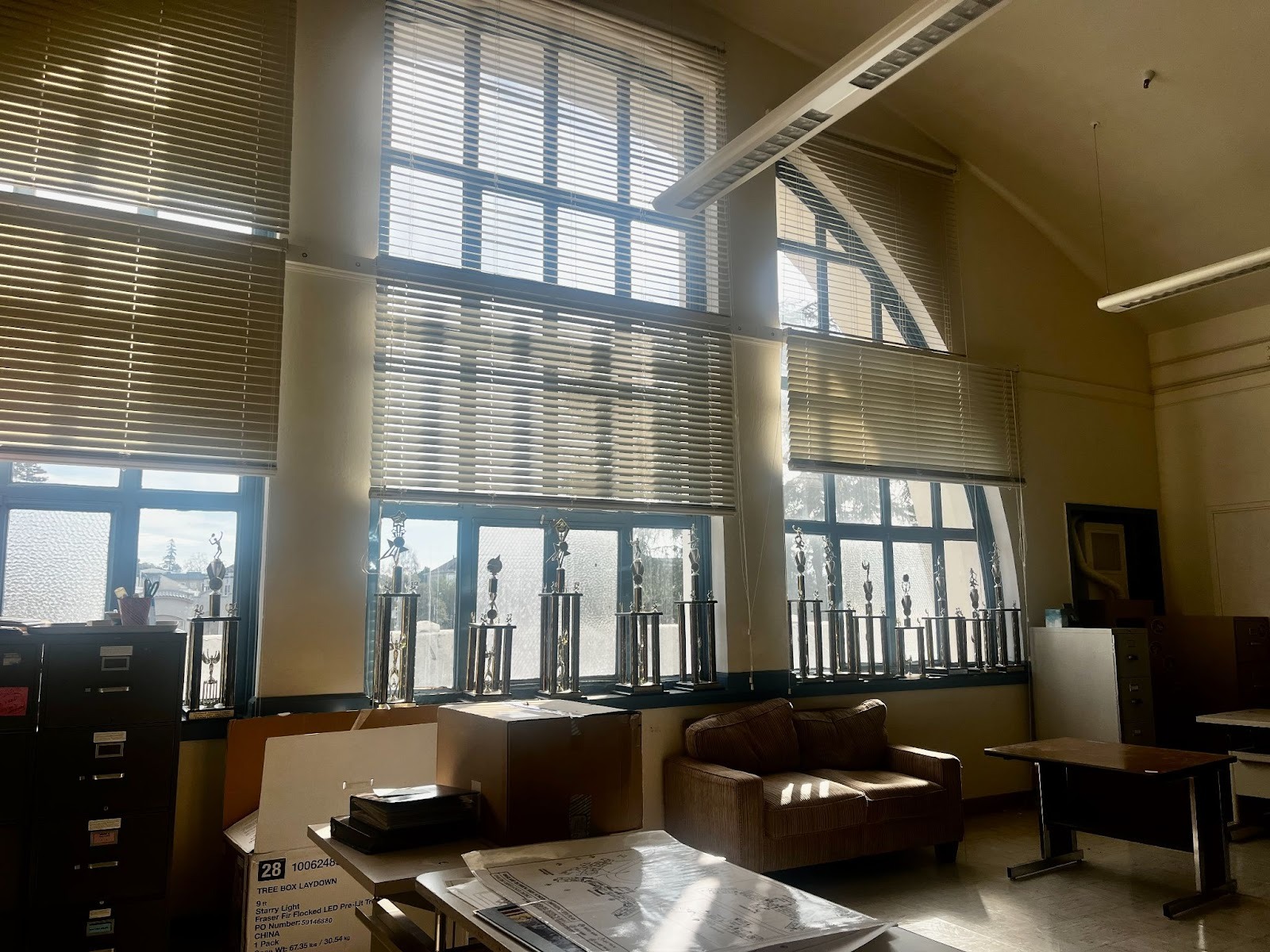
One space that comes to mind is the third floor, almost like a ghost story of Oakland Tech. Most students only know that no one really goes up there and its use is unknown. Access requires a key to the elevator, which clanks all the way up the school’s shafts. The landing itself feels like an archive: deconstructed signage from the school’s production of “Chicago” sits in a cardboard box, while the door to the actual room is cluttered with signs from APUSH exams reading “testing in progress.” Behind the door is a window that consumes the wall facing outward to Broadway Terrace and allots plenty of light into the space. The windowsill beneath it is lined with various trophies from the 1960s and ‘70s that Jefferies jokes never made it to the trophy case downstairs. The rest of the room is storage —desks, loveseats, cabinets, and files— but it also serves as a space for private conferences between students and staff members.
Though one room seems to have vanished from Tech’s public eye. Few people realize that another auditorium exists on campus, hidden in plain sight behind a nondescript door marked “Electrical Storage.” Where walls once held operas, plays, orchestras, and an original Maynard Dixon mural, the historic space is now splintered and lined with electrical panels. Until the opening of our current auditorium in 1961, this inner auditorium was the centerpiece of Tech, though mystery has seemed to coat it since the mural “disappeared.” Dixon, famous for his impressionist depictions of the American West, was commissioned in 1927 to paint a 60×9 ft mural for what would be nearly $30,000 today, though the mural itself would likely be worth millions. As an archived Scribe article wrote, “no one seems to know what happened to it or where it might be stored.” It may be sitting in one lucky man’s basement, but who knows. Its ability to disappear, from the auditorium and later from our knowledge that it ever existed, is telling of how changes within our school, both subtle and as large as a 60×9 ft mural, can alter our entire experiences on campus without us really noticing.