
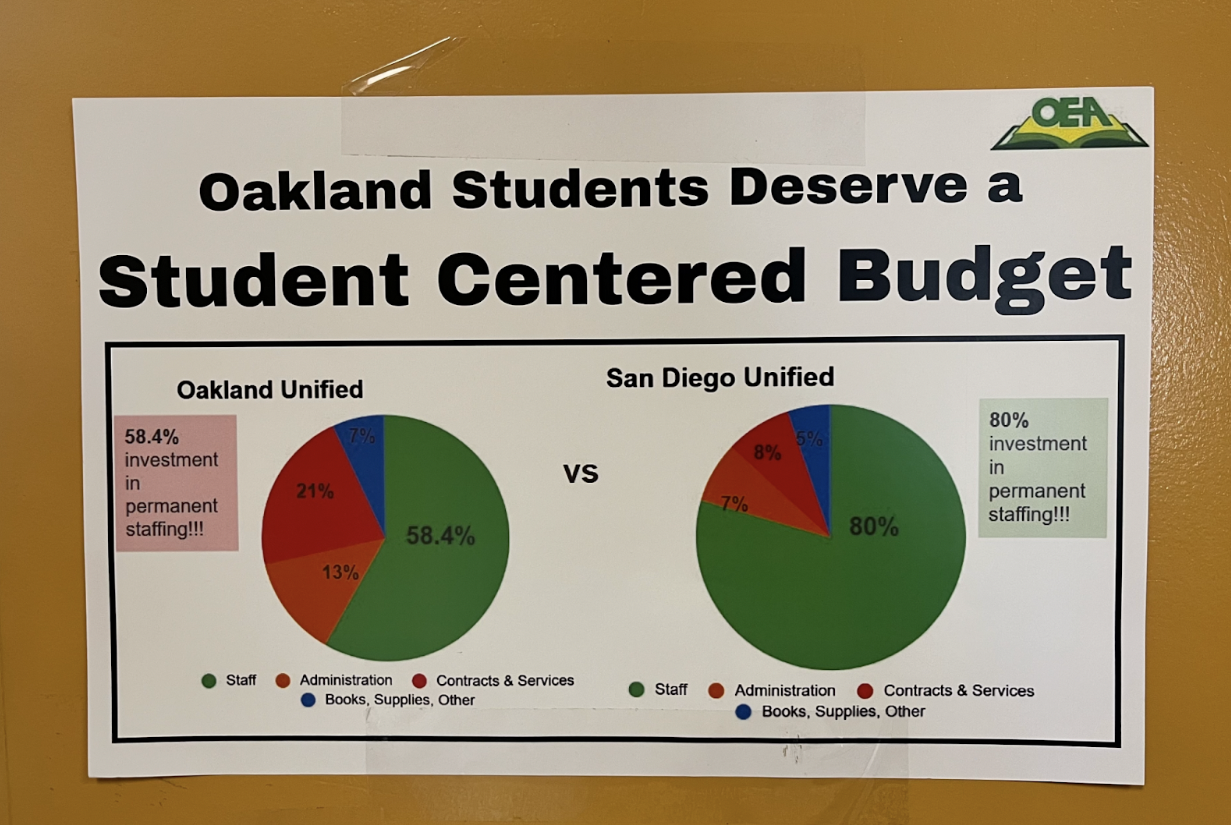
The Oakland Unified School District (OUSD) budget for 2025-26, which will cut around $100 million, was conditionally approved on November 1 by the Alameda County Superintendent of Schools, Alyssa Castro. The one-time federal pandemic relief funding has run out, and the dire financial situation will cause budget cuts affecting how schools, and the district as a whole, will function.
“My primary focus is to make structural changes now that lead to a sustainable budget, breaking the cycle of yearly cuts that hurts our students and staff,” noted OUSD School Board member Rachel Latta.
OUSD has struggled to properly manage finances in the past and has only recently come out of state receivership, where all of the districts’ plans and agreements must be approved by the state. When a school district cannot pay for salaries, employee benefits, services, supplies, and operating expenditures, it must apply for a state loan, which places the school in state receivership.
Latta is the only board member who is a current parent of students in OUSD, and she wants to see budget decisions that do not make differences to students’ experiences. She also aims to focus on cuts in the Central Office and administrations, which is a standpoint the Oakland Education Association (OEA) also holds. The OEA has expressed animosity towards the district’s refusal to increase salaries, even for a cost-of-living adjustment, which the state gives money specifically for. The district is strongly prioritizing staying out of state receivership.
OUSD currently has a $4 million monthly deficit, and likely budget cuts will be apparent in many parts of the district, including schools. In the past, to manage these issues, the district has resorted to school closures, which often make education more challenging for the students affected.
“I am highly skeptical that closures save money, and the data shows they disproportionately harm Black and disabled students,” said Latta.
The district is also preparing for the possibility of reduced federal funding for Titles l – lV, which could make a difference in the amount of resources supporting low-income and English-learning students.
“There’s no way to cut $100 million—roughly 20% of our unrestricted general fund budget—without significant pain,” stated OUSD Superintendent Dr. Denise Gail Saddler in a memo following the approval of the budget.
The district describes cuts to student services and instruction as inevitable, but the union and pro-union members of the school board expect that better management, decreased spending in the administration, and less contracting out for positions would make those cuts less necessary. Negotiations between the union and the district have been more testing with financial issues, and the OEA declared an impasse a few weeks ago.
“While the declaration of ‘impasse’ sounds alarming, it is actually a standard statutory step that brings in a third-party state mediator to help both sides bridge the gap,” explained Latta.
Other unions in the Bay Area are also at pivotal moments in negotiations, with West Contra Costa School District’s teachers going on strike for the first time and the San Francisco Unified School District (SFUSD) union nearly unanimously passing the first of two required votes to go on strike. The financial issues within OUSD mirror those of other Bay Area districts almost exactly, with unions asking for raises and cost-of-living adjustments and districts trying to cut millions of dollars from budgets.
The issue in OUSD may not be a lack of funding but a need for better distribution and management in budgets.
“The resources are there: contrary to the common narrative, OUSD has among the highest per pupil revenue of any district in the state, supported by incredible taxpayer and philanthropy support,” stated Castro in her letter to the Board approving the budget.
To stay out of state receivership, Castro emphasizes that OUSD will have to move forward with a priority for long-term solutions, stability and decisiveness. On Dec. 10, the vote to finalize budget balancing will take place.