
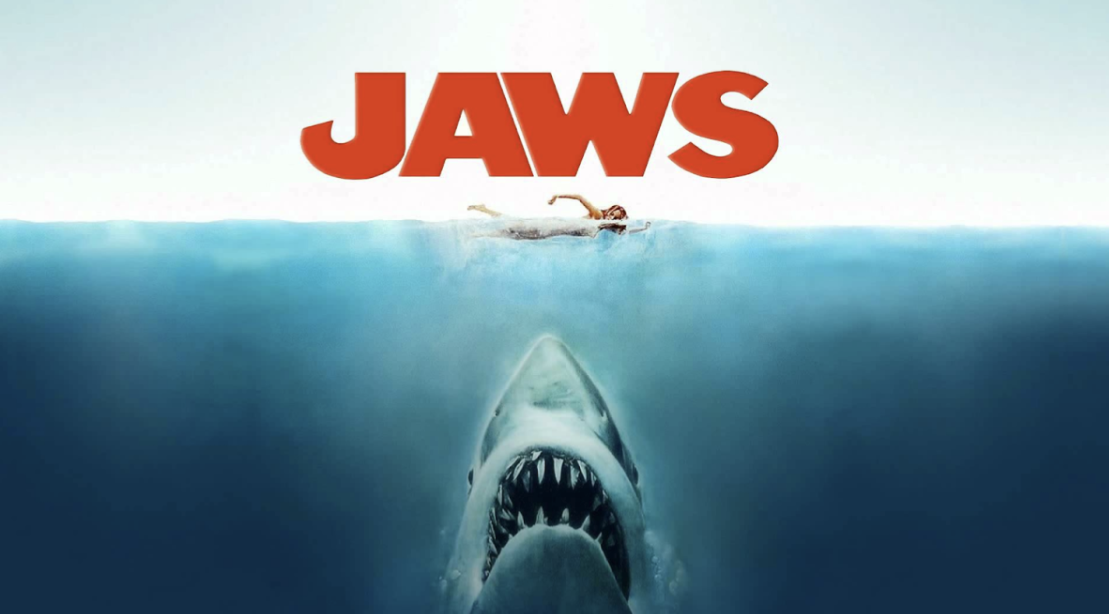
Jaws is a classic. It is rare that you encounter someone who has never once seen or heard of the film. Released in the summer of 1975, Jaws was an immediate blockbuster, a worldwide event, and a kick-starter to a new era of filmmaking. This summer marks the 50th anniversary of Jaws, which makes us wonder how it has managed to change the film industry forever.
Jaws is one of the main contenders when it comes to a horror movie night, a common go-to. But why is that? Scientifically speaking, we are not sharks’ favorite item on the menu, yet many of us have this subconscious fear of these sharp-toothed fish making us their snack. Jaws appeals to this irrational fear of a large great white shark prowling in coastal waters.
The masterful cinematography of the film captivates and evokes fear in the audience, as they are introduced through “predator perspective,” the shark’s point of view. Most of what we see during the shark attack scenes is the fin of the shark poking out of the water and the victims being pulled under. Suspense is built as we do not see the creature until it launches itself onto the shark hunter’s boat and devours him alive at the end of the film. Suspense is further amplified by the rhythmic tension built with a simple but unsettling score, toggling between notes of E and F.
The creation of Jaws marks the departure from a period commonly known as the “Hollywood Renaissance” and the beginning of the blockbuster filmmaking era. During the “Hollywood Renaissance” Auteur directors focused on making a specific vision of theirs come to life through a film; they had significant creative control over all aspects of the film. However, after the large-scale success of Jaws, there was a new shift to studio-driven films. The collaborative work of many producers behind a blockbuster film production led to large releases and global advertising to gain popularity.
Jaws was made on a $9 million budget, with $1.8 million spent on advertising. Trailers reached home televisions all over the globe, and the film soon became a worldwide sensation, making over $470 million in return. Following the success of Jaws, film studios increased their investment in advertising.
As we celebrate the 50-year legacy of Jaws, it is important to remember that the film was not just successful, but it birthed a new era of studio driven filmmaking, as a global audience became captivated by the shark centric horror.