
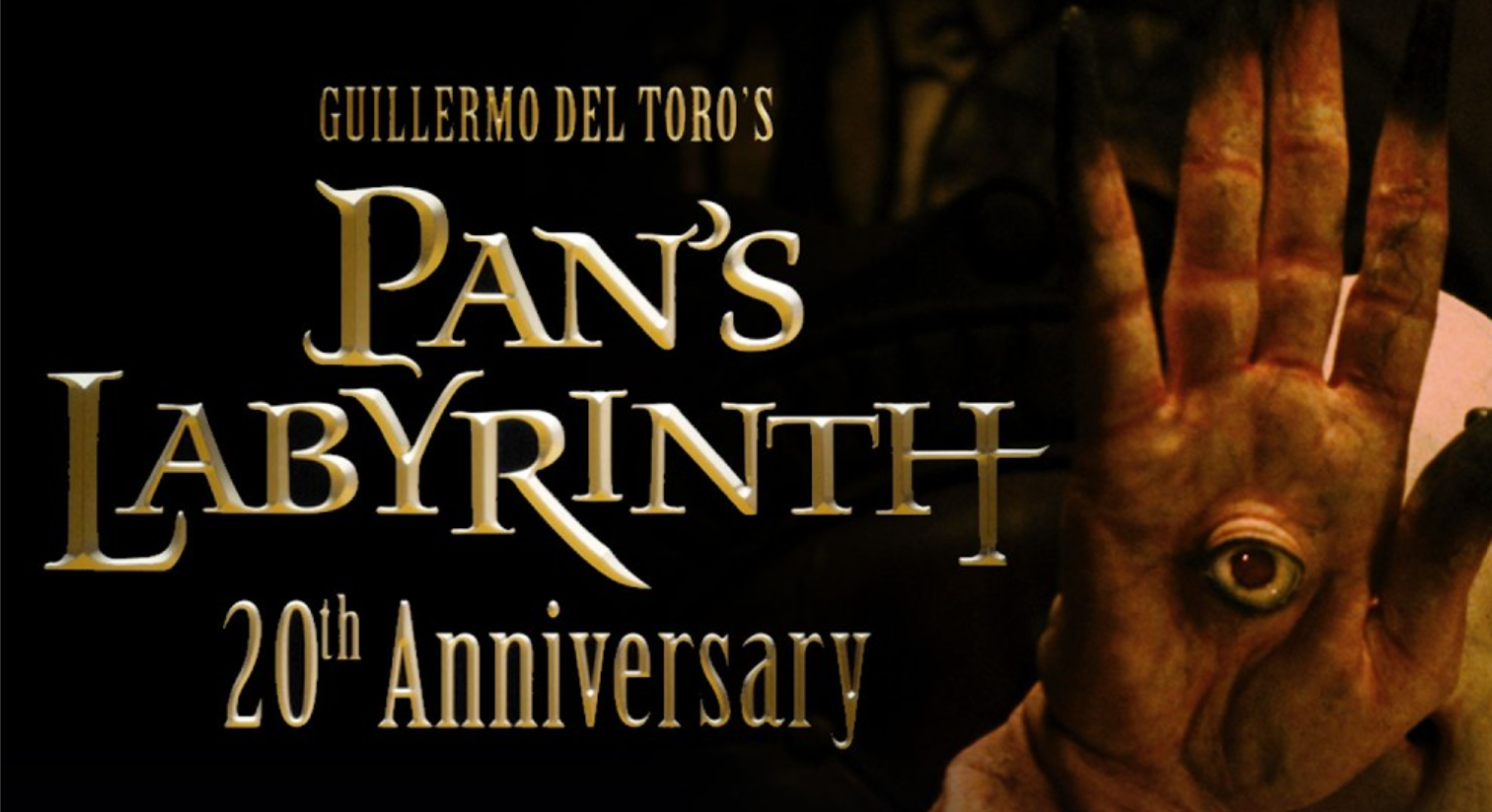
Guillermo Del Toro’s Academy Award-winning dark fairy tale “Pan’s Labyrinth” returned to theaters on October 9th to celebrate the film’s 20th anniversary.
“Pan’s Labyrinth” (El laberinto del fauno) is a 2006 Spanish-language dark fantasy produced, written, and directed by Guillermo Del Toro. It is regarded as a fairy tale for adults, where the horrors of both reality and fantasy blend into an extraordinary, spellbinding fable.
Taking place in the summer of Francoist Spain, 1944, the story follows 10-year-old Ofelia, who moved to a remote military outpost with her heavily pregnant and ill mother, Carmen. Her stepfather, Captain Vidal, is a cold and fiercely sadistic officer stationed to hunt down an anti-Francoist rebel group in the woods. Ofelia follows a large stick insect (which she believes is a fairy) into an ancient, stone labyrinth near the property. At its center, she meets a towering, ancient Faun who reveals that Ofelia is actually a princess, daughter of the King of the Underworld. To prove her worthiness, the Faun tasks her with completing three dangerous trials.
In celebration of its 20th anniversary, the movie was rereleased in theaters nationwide. Supervised directly by Guillermo Del Toro, it was remastered in 4k HDR and a newly crafted 3D conversion. Del Toro also gave statements regarding the film’s milestone and the return of its importance and deeper meanings.
The film emphasizes themes of fascism and the critical role of art and storytelling as resistance. It serves as a dark parable about the dangers of unquestioning obedience, the rise of authoritarianism, and the defense of humanity against systemic cruelty.
The film shows the tragedy of willful complicity, nodding to the people in today’s society who believe that if they comply and play by the rules, the system will protect them. Carmen complies with every order from Vidal, which eventually leads to her death. Her character is a warning that compromising your fundamental values or staying quiet in the face of unjust behavior does not guarantee safety.
Ofelia encounters a horrifying monster during her second task. The Pale Man sits at the head of a massive banquet table overflowing with food, yet he chooses to brutally slaughter and consume any creature that touches a single part of his hoarded wealth.
Del Toro has explicitly stated that the Pale Man represents the church, fascism, and institutional greed. He shows extreme wealth inequality and corporate hoarding. While millions face food insecurity and economic hardship, a small elite class holds immense resources.
The movie also points to the dehumanization of blind obedience. People who have stripped away their own humanity to obey a cruel, unjust order without question, requires a person to turn themself into a mindless tool. Our world, as it is, is seeing the return of the demand for submission put in place by the ruling classes. Through the story we see disobedience isn’t always bad, but important to helping us stay free.
In Del Toro’s 20th-anniversary reflections, he noted that it is deeply unfortunate the film remains so timely, pointing to a world shaped by the whims of “barely socialized trillionaires” and a global resurgence of dictatorships. During an interview on Latino USA with Maria Hinojosa, he reflected on how the film’s themes of fascism, violence, and human empathy remain urgent today.
For 20 years, this magical dark fantasy story has been shared with the world. Through its beautiful storytelling, world, and meanings reshaping the genre and connecting people with its art, this film holds special importance and relevance to our present time. As said by Guillermo Del Toro, “We are living in the world of Pan’s Labyrinth.”