
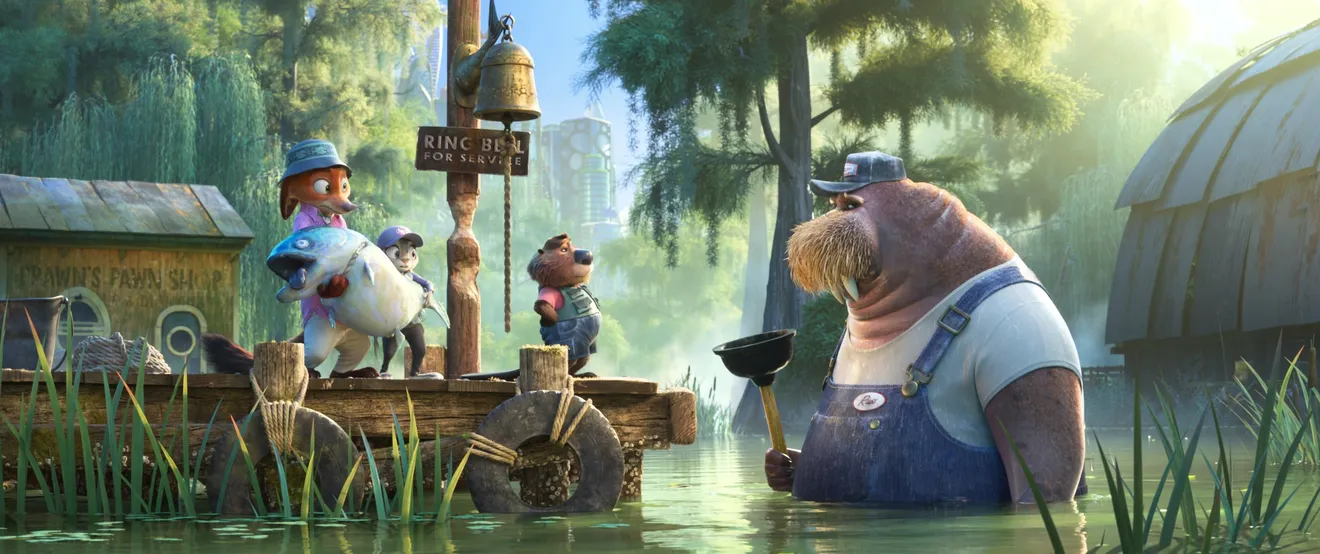
After nine years of waiting, “Zootopia 2” was released into theaters two months ago, leaving major critiques on today’s society. Judy Hopps and Nick Wilde’s platonic bond evolves at center stage of the film as they work to uncover the mystery of why “unwelcome” reptiles are appearing in Zootopia. While Nick and Judy overcome many personal challenges, the film as a whole brings many complex subjects and themes found in our world to light.
“Zootopia” is a city where all mammals are welcome to live harmoniously in a perfectly controlled climate. In Zootopia, false propaganda depicts reptiles as malicious creatures who do not belong in their utopia. Mostly, they have been pushed out by the prestigious Lynxley family and denied residency in Zootopia.
Minority groups being forced out of their neighborhoods by wealthier gentry moving into their space is an example of how Zootopia touches on the topic of gentrification. Gentrification causes forced displacement and culture destruction of many communities due to growing housing costs. The marginalized snakes and reptiles being forced to live in an undesirable swamp environment is a depiction of gentrification.
Many parts of Oakland, including West Oakland, downtown Oakland, and certain areas of North Oakland, have experienced intense gentrification. In those areas, low income residents forcibly relocated due to growing housing costs, while wealthier households moved in because higher costs of living allowed them to. Between 1990 and 2011, West Oakland’s African American population decreased by 25%, as more white residents moved in.
Redlining, further reflected in Zootopia 2, is the practice of denying crucial human services to residents of targeted areas. In the film, reptiles are denied city services, residency, public amenities and legal protections. Reptiles live in a gloomy, muddy, overcrowded, and swamp-like environment.
Redlining reigned over our society from 1934-1960s, yet continues to have lasting effects in Oakland. Historically, neighborhoods with a large portion of Black, Asian, and Hispanic residents were labeled as “risky” and outlined in red.
This system, largely institutionalized by the federal government, made it so that residents living in redlined zones of Oakland were denied the right to get mortgages. Despite the practice being outlawed decades ago, previously redlined communities have been left to deal with generations of injustice and unhealthy living conditions. While Oakland is a diverse city, many neighborhoods lack “racial integration” due to the lines that once segregated our city.
The film comes to a close with an excessively ideal ending. The Lynxley family is arrested and punished for the crimes they committed and for creating an unfair prejudice in Zootopia against reptiles. Then, the reptiles are granted their very own weather controlled environment in the City of Zootopia. This bubbly ending leaves viewers with the question of whether or not our society will ever be able to overcome centuries of inequality and disenfranchisement. Though the film makes it seem like our societal problems can be fixed within a day, in reality we are just beginning the process of reaching an improved, welcoming world.