
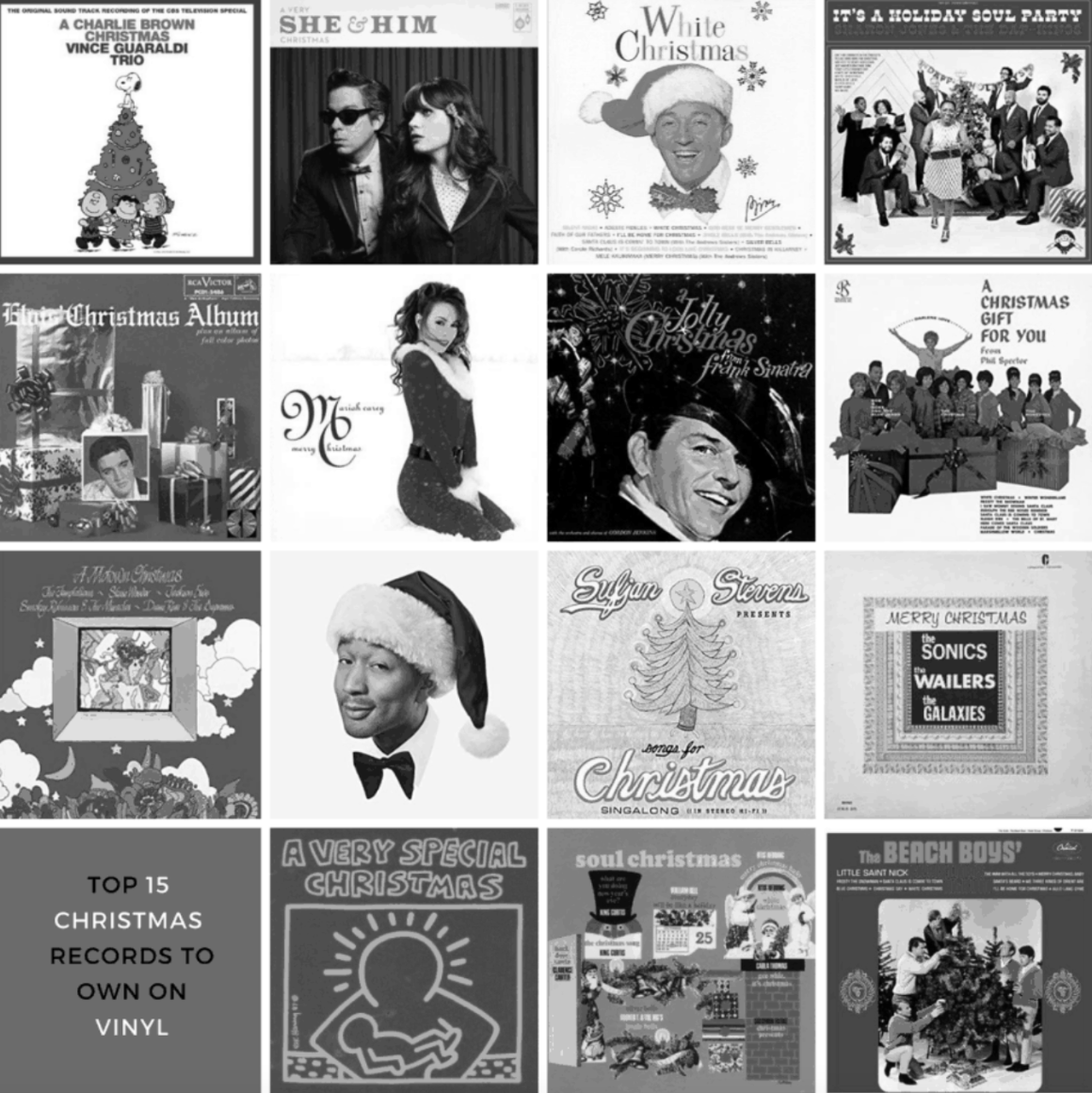
Since the 1930s and ‘40s, the number of Christmas albums has been steadily rising and is now in the thousands. Whether you turn on the radio or walk into a store during the month of December, Christmas music will probably be playing. It begs the question: Why has music become such a staple of the Christmas tradition?
Christmas albums and songs initially gained popularity in the 1930s as a result of radio and recorded music. But as times changed, so did music. Modern popular Christmas songs are not really about Christmas anymore; instead, many are about love. For example, in both Mariah Carey’s “All I Want for Christmas Is You” and Wham’s “Last Christmas,” Christmas is just the background, not the focus of the song itself.
Similarly, the genre of Christmas rom-coms has exploded in the past few years, tracing back to 2003. In 2003, around 25 Christmas movies came out, one of them being “Love Actually,” a rom-com. It was incredibly popular and demonstrated the potential of Christmas rom-coms, leading to the mass quantity of Hallmark Christmas rom-coms that has taken over the genre.
The movie also showed the connection between Christmas music and movies, featuring “All I Want for Christmas Is You” in one of its pinnacle scenes. This almost singlehandedly propelled the song back into mainstream popularity, especially among kids. Mariah Carey’s career was in a lull at the time, and though the song was released in 1994 to moderate success, it was nowhere near the level it is now, thanks to “Love Actually.”
The movie wouldn’t be the same without the song, either. They enhanced each other, rising together as the vanguards of a romance-focused Christmas. Only 20 years after “Love Actually” came out, over a hundred Christmas movies were released. Forty-two of them were Hallmark movies, all of which were rom-coms.
Even the pop-punk band Blink-182 joined in on the modernization of Christmas music, releasing the song “I Won’t Be Home for Christmas” in 2005. It coincided with the second wave of pop-punk in the early 2000s. The song is very untraditional for Christmas music. It criticizes Christmas with lyrics like, “I’m growing tired of all this Christmas cheer.” Its fast paced and upbeat tempo is entirely unlike other Christmas music and the opposite of traditional Christmas carols. Even its title is mocking the 1940s song “I’ll Be Home for Christmas.”
Even though adapting alongside popular culture has maintained the prominence of Christmas albums, a 2018 study by NORC at the University of Chicago showed that Americans prefer traditional Christmas music over modern music. In the same year, “All I Want for Christmas Is You” broke the top 10 of the Billboard Hot 100 for the first time ever, skyrocketing back to popularity, which has only continued until today.
The genre of Christmas music has something to offer almost everyone because it has changed so much with a variety of subgenres. Our Oakland Tech music teacher Mr. Poree has covered multiple Christmas songs and albums and grew up listening to classic Christmas music. Later on, he branched out into music involving other spiritualities beyond just Christian Christmas, like Santería and Hinduism.
“Music is social—you play it with others and connect with them, but it’s more than that,” Mr. Poree claims. “Science has been trying to find why pitches make you feel a type of way… It’s a combination of actual physics: vibrating, creating waves within us, since we’re 60% water… It’s biological and social.”
Music is almost magical; it is hard coded into us. Music is a reflection of ourselves and designed for us to enjoy. It is a part of every society and culture. Christmas albums are such a staple of Christmas because there would be no Christmas culture without music.