
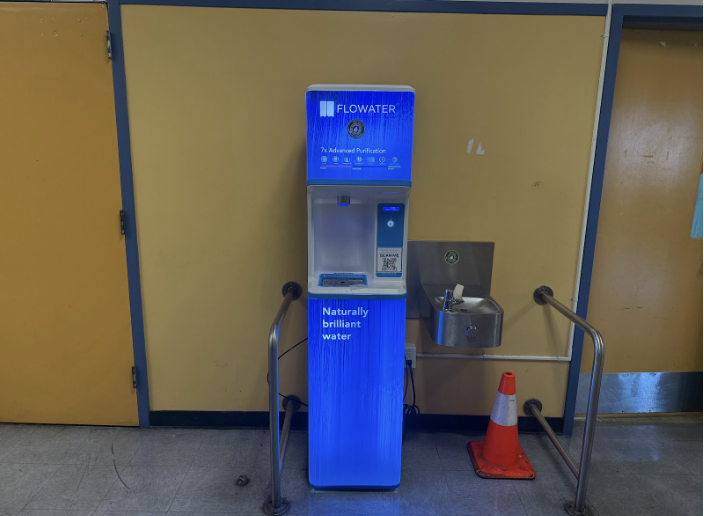
Oakland Tech has struggled with lead in its waters for decades. Old pipes, out-of-date fountains, and worn infrastructure have made many drinking sources unsafe. Over 75 years of use has left the system in serious need of repair. This year, new FloWater stations were installed across campus with improved filters that last longer than the old ones. While this seems like a step forward, the question still remains: Are the FloWater stations safe to drink from? The short answer: Yes.
The new FloWater stations have become necessary due to high levels of lead. According to recent OUSD lead water reports, many fountains have shown detectable parts per billion (ppb) of lead. For example, the September 2 report showed that the water fountains outside of S5 had 69 ppb after the first 125 milliliter (mL) sample, 11 ppb after the second 125 mL sample, and 6.4 ppb after the final 125 mL sample. These readings exceeded both the EPA limit of 15 ppb and OUSD’s stricter five ppb standard. By October 9, results from the same fountain had dropped sharply—1.8, 2.0, and 0.76 ppb in consecutive samples. These met both EPA and OUSD standards. In addition, water from tested FloWater stations came back as non-detectable for lead, showing real improvement.
According to Preston Thomas, head of Buildings and Grounds at OUSD, FloWater stations use reverse osmosis to remove lead and other contaminants. However, he emphasized that this is not the final solution. The district’s long-term goal is to modernize Tech and many other OUSD schools with outdated buildings, pipes, and infrastructure.
Ms. Hare, an expert on Oakland Tech’s lead situation, explained that while progress has been made in improving water safety, there is still a significant amount of work that needs to be done—not only at Oakland Tech but across all campuses in OUSD. She also noted that all the FloWater stations on campus rely currently on electricity. In the event of a power outage, these stations would be unusable. Since the traditional fountains around campus are still unsafe to drink from, students would be left without access to safe drinking water.
To address this, Ms. Hare introduced OUSD’s multi-year plan to upgrade Tech’s water facilities, which includes installing non-electric FloWater Stations. These were supposed to be installed over the summer—outside of the Boys’ Gym and near the bathroom outside of the S-Building—to provide safe drinking water for athletes and theater kids who stay after hours. However, these were never installed. Ms. Hare hopes this will happen soon, as recent reports show the fountains next to the Boys’ Gym and S-Building are unsafe to drink from.
Oakland Tech is over 125 years old and has not received major internal renovations for decades. OUSD has developed a plan to address the school’s aging water infrastructure issues. The modernization of water systems at Tech and OUSD will continue with the next phase of the plan, which involves replacing all the bubblers and pipes. Renovations will need to be made from the ground up, as every drinking fountain will be affected. This process will be very expensive and time-consuming, with completion projected around 2027-2028.